
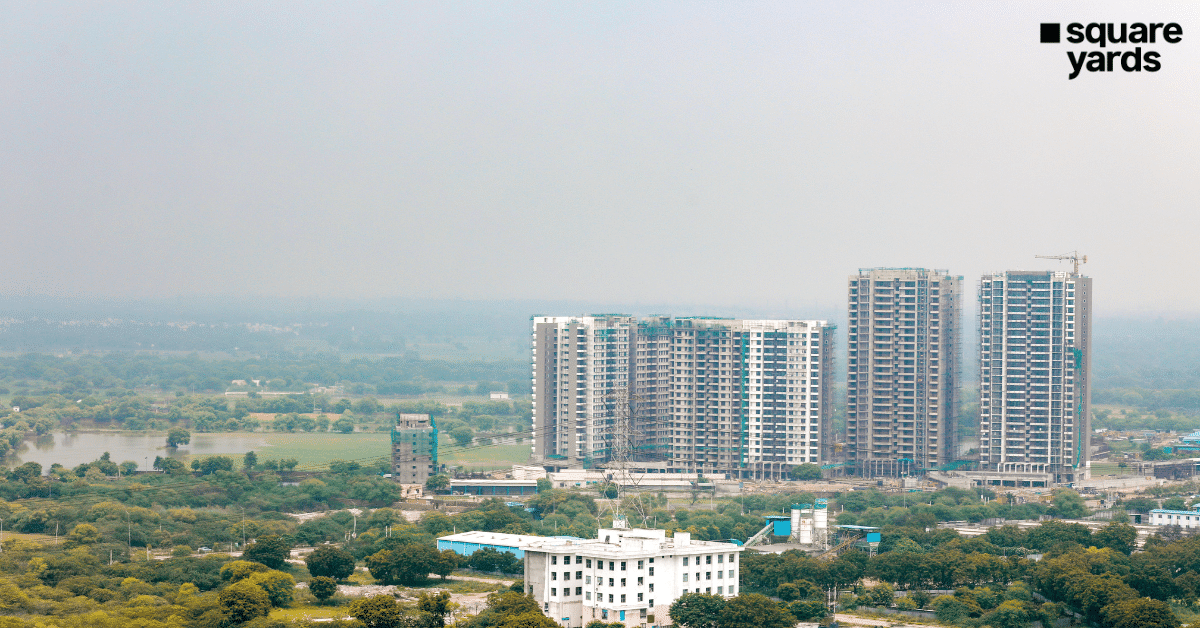
New Noida’s planned expansion could reshape demand beyond core Noida. Here’s what investors and end-user buyers should watch before taking a call.
Noida has been one of the strongest real-estate markets in Delhi NCR for both end users and investors, but the city is also facing a familiar urban problem: limited fresh land in established sectors. As supply tightens in mature locations, launch prices in prime pockets tend to move up faster than many middle-income buyers can comfortably absorb.
That is where the proposed New Noida master plan, also referred to in the source as the Dadri-Noida-Ghaziabad Investment Region (DNGIR), becomes important. The cited source says this expansion covers 20,000 hectares and is intended to support future residential and industrial growth once existing Noida’s land availability becomes more constrained.
For real estate investors and end-user buyers, the real question is not simply whether New Noida sounds promising. The better question is: how should one read early-stage master-plan news without getting carried away by speculation? In Indian property markets, a plan on paper, land acquisition on ground, infrastructure execution, and actual liveability often move at different speeds.
This article takes a balanced view of the available facts from the source and translates them into practical buying and investment insights for readers looking at Noida, Greater Noida, YEIDA-linked corridors, and the broader NCR growth story.
What the New Noida plan appears to signal
The source states that existing Noida is about 90% built across 168 sectors, which explains why land in core sectors is becoming harder to source. In practical market terms, this usually leads to three outcomes:
- fewer large land parcels in established zones
- higher land cost for fresh launches
- stronger premium positioning by developers in central locations
The same source says the New Noida plan adds 20,000 hectares of urban expansion. If implemented as planned, that is a major supply-side intervention designed to absorb future industrial and residential demand.
Why this matters to buyers
For an end-user buyer, new planned areas can create future options at lower entry points than mature sectors. But lower entry price should not be confused with immediate liveability. Social infrastructure, roads, public transport, schools, hospitals, and retail ecosystems take time to stabilise.
For an investor, early-stage growth corridors can offer better long-term upside than fully saturated locations. However, investment success depends on actual execution, not just announcement headlines.
Sourced fact vs market interpretation
- Sourced fact: The article references a 20,000-hectare expansion and describes it as DNGIR/New Noida.
- Interpretation: This could reduce future supply pressure in the wider Noida region if land assembly, planning and infrastructure progress on schedule.
Independently verify before making an investment decision.
Why core Noida pricing is pushing demand outward
According to the source, average asking prices in core Noida are around Rs 12,650 per sq ft, while some new launches are cited at about Rs 19,650 per sq ft. It also mentions Greater Noida West in the range of roughly Rs 8,500 to Rs 8,750 per sq ft.
These figures are useful not because they guarantee future pricing, but because they show the affordability gap between established and emerging micro-markets.
What this means in real terms
A buyer with a fixed budget often has to choose between:
- a smaller unit in a mature Noida location
- a larger apartment in Greater Noida West or another developing belt
- waiting for newer supply in an expansion corridor like New Noida
Simple affordability comparison from the source
| Market | Indicative rate from source | Approx base cost for 1,200 sq ft | |---|---:|---:| | Core Noida average | Rs 12,650 psf | Rs 1.52 crore | | Core Noida new launch | Rs 19,650 psf | Rs 2.36 crore | | Greater Noida West | Rs 8,500–8,750 psf | Rs 1.02–1.05 crore |
Note: These are source-based indicative base costs only. Stamp duty, GST where applicable, PLC, parking, club charges, IFMS, registry expenses and fit-out cost are extra.
Buyer takeaway
If your priority is immediate possession, established connectivity and stronger civic ecosystem, core Noida may still justify a premium for some families.
If your priority is budget efficiency, larger configuration and future appreciation potential, outward growth zones become more relevant.
That said, investors should avoid assuming that every lower-priced expansion area automatically delivers superior returns. Rental yield, holding capacity, infrastructure readiness and resale depth matter just as much as the launch price.
Jobs, industry and grounded investment: the real demand drivers
One of the most important points in the source is not the size of the land parcel, but the employment story linked to it. The article says New Noida is targeting 5 lakh to 6 lakh jobs by 2030 and mentions Rs 35,000 crore across 120 projects as already grounded.
Why employment matters more than hype
In real estate, sustainable housing demand usually follows jobs. Where there is a cluster of:
- manufacturing
- logistics
- warehousing
- data centres
- electronics production
there is usually a need for workers, managers, vendors, transport support, retail and services. That creates a broader housing ecosystem over time.
Rental demand often arrives before end-user demand
In Indian growth corridors, the usual sequence is:
- industrial or infrastructure work begins
- rental demand emerges from employees and contractors
- support businesses enter the area
- owner-occupier buying improves once confidence increases
This is especially relevant for investors comparing capital appreciation versus rental yield. Early-stage zones may take time to produce strong rental depth, while nearby established locations may benefit first from spillover demand.
Important caution
The source uses the word grounded, which suggests projects have moved beyond announcements. Even so, investors should separately verify:
- project location mapping
- implementation stage
- access roads
- utility readiness
- likely employee catchment and residential preference
Independently verify before making an investment decision.
Land acquisition, farmer compensation and why execution matters
A major reason many township or regional plans get delayed in India is land acquisition friction. The source says farmer compensation has been increased to Rs 6,459 per square metre, describing it as a 53% hike.
Why this is a meaningful signal
Higher compensation can indicate that the authority is trying to reduce resistance and move acquisition forward more smoothly. In practical terms, this may improve the credibility of the expansion versus plans that remain only conceptual.
But buyers should be careful here.
A higher compensation number does not mean immediate readiness
Even if compensation improves acquisition momentum, several things still need to align:
- contiguous land handover
- sector planning and notifications
- trunk infrastructure
- sewage, drainage and power planning
- transport integration
- developer participation
- phased residential delivery
Legal and due-diligence angle
Before booking in any early-stage corridor, check:
- whether the parcel is under a notified authority plan
- whether the land is freehold or leasehold
- whether the plotted or group housing project is RERA-registered, where applicable
- whether access road commitment exists on ground
- whether registry timelines are clear
- whether there are any title, compensation or litigation issues
This is where many retail buyers make mistakes. They focus on the brochure and ignore legal hygiene. In expansion corridors, title clarity and planning status matter even more than pricing.
How investors and end users should approach New Noida differently
The same location can make sense for two buyers in completely different ways.
If you are an end-user buyer
Your checklist should be practical:
- How far is the site from your workplace?
- Is there functional connectivity today, not just proposed connectivity?
- Are schools, hospitals and daily retail usable within a reasonable distance?
- Is possession realistic based on stage of development?
- Will your family be comfortable living there in the next 3–5 years?
For end users, buying too early in an underdeveloped corridor can create lifestyle friction even if the long-term story looks attractive.
If you are an investor
Your lens should be more numbers-driven:
- entry price versus nearby established market
- supply pipeline and future competition
- potential rental catchment from industry and offices
- holding period capacity
- exit depth during resale
- authority-led infrastructure progress
A sensible strategy split
| Buyer type | Better focus | |---|---| | End-user | liveability, possession, commute, social infrastructure | | Long-term investor | land economics, job engine, infrastructure phasing, resale cycle | | Rental investor | proximity to employment nodes, tenant profile, maintenance viability |
Opinion-based view
In our assessment, New Noida is likely to be more relevant initially for patient investors and strategic buyers than for families seeking immediate mature-city convenience. This is an interpretation, not a sourced guarantee.
Practical due diligence before buying in any new growth corridor
Whether you are evaluating New Noida, Greater Noida West, or a YEIDA-linked sector, disciplined due diligence is non-negotiable.
1) Verify planning status
Check the applicable authority framework and exact sector/location mapping. Do not rely only on sales presentations.
2) Check RERA details
If the offering falls under RERA applicability, review registration, phase details, promised possession, and past compliance history.
3) Understand land tenure
Many NCR buyers ignore the distinction between freehold and leasehold. This affects long-term comfort, transfer perception and sometimes buyer preference during resale.
4) Study total acquisition cost
Your cost is not just BSP. Evaluate:
- PLC
- EDC/IDC if applicable
- parking
- club charges
- IFMS
- GST where applicable
- stamp duty and registry
- fit-out/interior cost
5) Compare with nearby live markets
Do not assess an expansion corridor in isolation. Compare it with:
- occupied sectors in Noida
- Greater Noida West resale and new-launch inventory
- Yamuna Expressway/YEIDA growth nodes where relevant
6) Track infrastructure, not rumours
Metro links, expressway access, industrial job creation and civic utilities are all major value drivers. But only executed infrastructure creates real value.
7) Have an exit plan
Before buying, answer this honestly: if the market takes longer than expected, can you hold the asset without stress?
That one answer often separates a wise investor from a speculative buyer.
Key Takeaways
- The source positions New Noida as a 20,000-hectare expansion intended to ease future land scarcity around Noida.
- Rising prices in core Noida are pushing many buyers to compare mature sectors with emerging corridors such as Greater Noida West and New Noida.
- Employment creation and grounded industrial investment matter more for long-term housing demand than headline announcements alone.
- Land acquisition progress is a positive signal, but it does not eliminate execution, legal and infrastructure risk.
- End users should prioritise liveability and possession confidence, while investors should focus on holding power, infrastructure phasing and resale depth.
Frequently Asked Questions
What is New Noida in simple terms?
Based on the source, New Noida refers to a planned 20,000-hectare expansion also described as the Dadri-Noida-Ghaziabad Investment Region. It is intended to support future industrial and residential growth beyond existing Noida.
Is New Noida good for end-user home buyers?
It may be relevant for end users who can wait for infrastructure and ecosystem development. Families needing immediate liveability should compare current connectivity, schools, hospitals and possession certainty very carefully.
Why are investors interested in New Noida?
Investors typically track new corridors when mature markets become expensive and land supply tightens. The source also links the area with jobs, industrial activity and grounded investment, which are important long-term demand signals.
Will property prices definitely rise because of the master plan?
No responsible buyer should assume guaranteed appreciation. Price movement depends on execution, land acquisition, infrastructure delivery, supply pipeline and actual end-user demand. Independently verify before making an investment decision.
Should I buy in core Noida or an emerging corridor?
If your priority is immediate convenience and established neighbourhood quality, core Noida may suit you better. If budget flexibility and long-term growth potential matter more, an emerging corridor may be worth evaluating.
What documents should I check before booking?
Review RERA details where applicable, land title, allotment status, approved plans, payment schedule, possession commitments, leasehold/freehold terms, and all extra charges including registry and maintenance obligations.
Conclusion
New Noida is important not because it is just another headline, but because it reflects a broader truth about the NCR market: mature Noida is becoming more supply-constrained and more expensive, so future growth has to move outward. The source points to land expansion, jobs, grounded investment and compensation-led acquisition progress as the core building blocks of that story.
For real estate investors and end-user buyers, the opportunity is real only if approached with discipline. New corridors can reward patient capital, but they can also test buyers who enter too early without checking legal status, infrastructure phasing and true end-user demand. A balanced approach is best: track the plan, verify the details, compare alternatives, and buy only when the asset fits your budget, time horizon and risk appetite.
If you are evaluating Noida, Greater Noida, YEIDA or upcoming growth corridors like New Noida, NeeVAasha can help you compare options, review location fundamentals and plan a practical site visit before you decide.
Talk to Rahul directly.
Have a specific question about this topic? Book a no-obligation call with Neevaasha's founder — 15 years of NCR real-estate experience, one honest conversation.


